
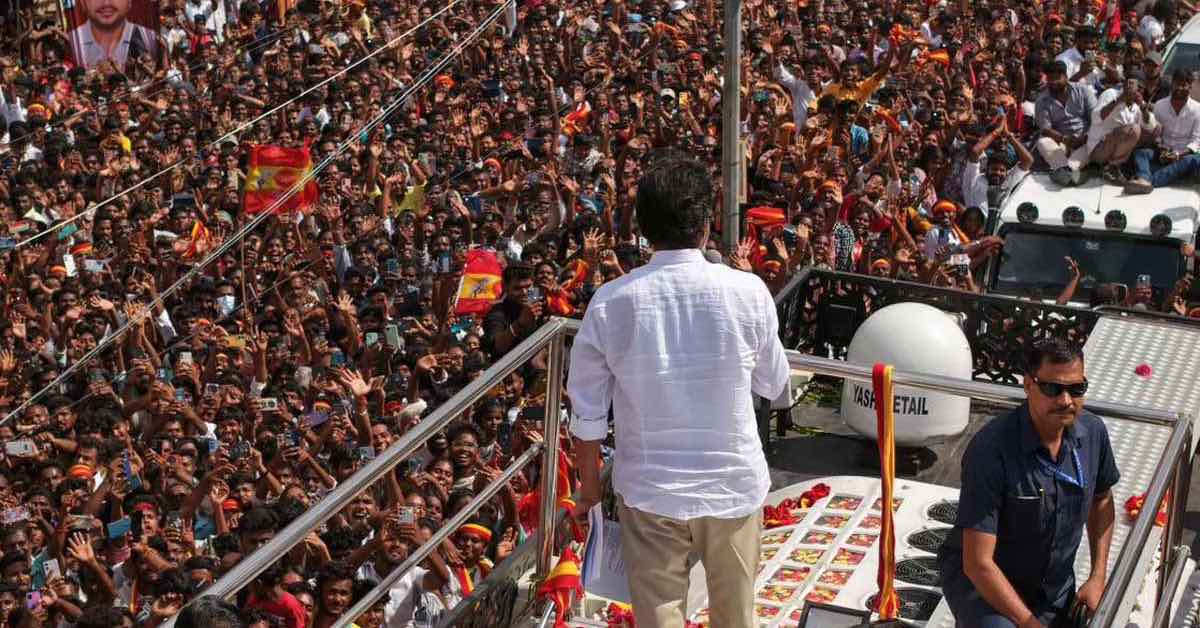
Vijay Karur Rally Stampede: Are we mere cockroaches?
When I first heard that Thalapathy Vijay was launching a political party, I could not help but recall my long-standing issue with his acting and on-screen presence. Despite this, when the announcement came, the crowd that turned up to see him was beyond imagination. Some reports claimed 14 lakh attendees at his events, while others more conservatively placed the figure between five to six lakh.
Regardless of the discrepancy, one thing was clear; these rallies were pulling more people than most major political leaders in the state could dream of. Vijay came out swinging against BJP, DMK, and almost every established party in Tamil Nadu, even going so far as to declare himself as a lion coming for them all. It was dramatic, it was bold, but most importantly, it was dangerous given the sheer volume of people who started gathering around him.
Things, however, took a darker turn on September 27, when a rally in Karur district spiraled into tragedy. The crowd size was once again overwhelming, and what was meant to be a show of strength ended in disaster. Reports confirmed that at least 39 to 41 people lost their lives, including children, while more than a hundred sustained serious injuries.
Stampedes are not unheard of in India, but the scale of this incident was shocking. A political rally that should have been controlled and planned turned into chaos, and yet, Vijay’s role in this cannot simply be brushed aside. Mass gatherings are complex to manage, but when someone commands such a following, the responsibility doubles.
The legalities of this Karur rally paint an even clearer picture of mismanagement. Official permission was granted for a gathering of 10,000 people, and police arrangements were made accordingly. Yet, the crowd that showed up was at least three times larger, with estimates ranging between 25,000 to 30,000, and some reports even citing up to 60,000. Whether these were genuine political supporters or cinema fans flooding the grounds to see their idol is secondary.
What matters is that the numbers were far beyond what was sanctioned. A leader with any sense of conscience should have realized the risks, halted the rally, and dispersed the gathering. Instead, the speeches continued, and what followed was inevitable disaster.
Eyewitness videos that circulated afterward raised even more troubling questions. They showed that even after the stampede began and while injured people were being rushed to hospitals in front of the stage (top of the van), Vijay did not immediately stop speaking. The rally carried on, and the chaos mounted until lives were lost. By the end of the night, over 40 bodies were counted, with children among the victims. Hundreds of others were injured.
And what did Vijay do as the situation unfolded? Instead of staying at the scene or offering immediate solidarity, he left the venue, traveled to Trichy airport about 70 kilometers away, and caught a chartered flight at 10:10 PM, reaching Chennai past midnight. For many, this looked less like safety precaution and more like desertion.
You could argue that Vijay prioritized his personal safety, and perhaps that is true. Yet the bigger question remains unanswered. What about accountability? Were the 40 people who died not as human as he was? Was there no empathy for the families who lost their loved ones that night? A leader cannot simply walk away when things go wrong. Yet in this case, it appeared as though his priority was distance rather than responsibility.
And when he finally broke his silence a couple of days later, the tone was defensive rather than empathetic. In a five-minute video, he lashed out at Tamil Nadu Chief Minister MK Stalin and the ruling DMK, accusing them of revenge politics and of targeting his party members with FIRs. Instead of showing remorse, the message was combative, as if politics were more important than human lives.
This points to a deeper problem with Vijay’s political project. Unlike other parties with collective leadership or recognizable second-tier figures, this is a one-man show. The brand is not the ideology; it is Vijay, Vijay, and more Vijay.
The immense crowds are not there to hear about policies or visions for Tamil Nadu’s future. They are largely there because their favorite film star has appeared in person. At least 75% of the masses are his fans first, political supporters second, if at all. This makes me question what we have become as a society. If the presence of a celebrity is enough to draw us in like moths to a flame, are we not behaving like Kafka’s cockroaches, reduced to seeking validation in someone else’s glow instead of leading our own lives?
The psychology of fan culture explains part of this and this isn’t something new to Tamil Nadu. We often blur the lines between actors and the characters they play, transferring admiration from fiction into real life. Add to that the drudgery of everyday existence and the lack of inspiring leadership, and suddenly a celebrity feels like the only escape or source of hope. These multimillionaire stars grace us with their presence, and we celebrate as though it were a blessing.
Yet in doing so, we only reinforce our own weakness. We should be striving to live as stars of our own stories rather than surrendering our agency to the glamour of another. Fanaticism; whether for dictators, celebrities, or influencers, is the root cause of our greatest social failures. We are not heroes of our own lives anymore, and this tragedy in Karur was a painful reminder of just how dangerous blind devotion can be.
