
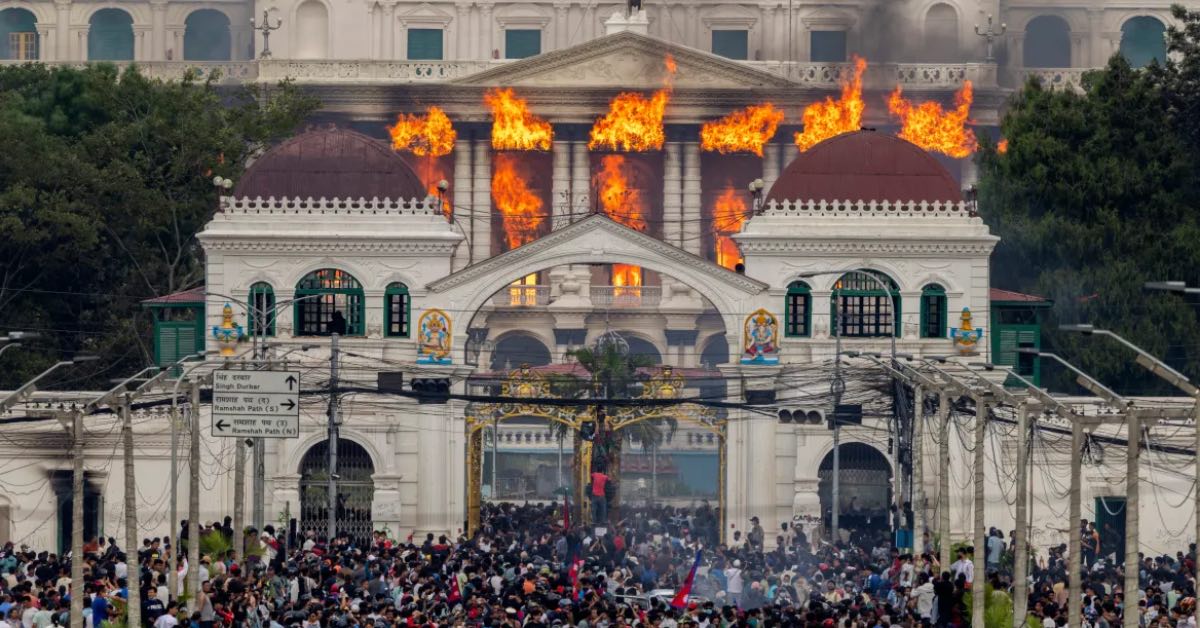
The burning Nepal protest
Many people online are saying that the Nepal protests happened only because of the social media ban. That is partially true, but it does not explain the bigger picture. To really understand this movement, we need to go back to 2006, when Nepal witnessed the People’s Movement. Also known as the Democracy Movement, it was directed against King Gyanendra’s absolute monarchy. The uprising forced the king to restore parliament, and for a moment, it felt like democracy had won a great victory.
But the promise of democracy did not last long. The new governments fell into corruption, extravagant lifestyles, and wasteful spending. Leaders were accused of wearing expensive clothes, living luxuriously, and ignoring the struggles of ordinary citizens. People who had once celebrated the end of monarchy soon felt betrayed. By 2022, this frustration boiled over into pro-monarchy protests, as many citizens openly said democracy had failed them. These protests dragged on, but it was the growing anger of the youth that eventually reshaped the situation.
Young people turned to social media to criticize their leaders. Platforms like Facebook, TikTok, and X became the spaces where corruption and misrule were called out. The government responded by tightening regulation of online spaces. Finally, on September 4, 2025, Prime Minister KP Sharma Oli, ordered the shutdown of 28 platforms, including Facebook, TikTok, and X. That move backfired instantly. It silenced the voices of Gen Z, and instead of controlling dissent, it triggered an eruption.
With no outlet left, thousands of young Nepalis took to the streets of Kathmandu and other cities. Their target was clear: the parliament and the symbols of power. At first, it was a peaceful protest. They marched toward the parliament in large numbers, demanding accountability. But when the police fired on them, killing nearly 20 protesters, the situation turned violent. The parliament was set on fire, the prime minister’s residence was attacked, and Finance Minister Bishnu Prasad Paudel was beaten on the streets. The Straw Hat flag and the bounty posters from One Piece were held high during the protest.
The anger spread rapidly. Multiple ministers’ houses were torched. Former Prime Minister Jhala Nath Khanal’s house was attacked, and in the chaos, his wife was killed. Nepal had not seen violence of this scale in recent memory. The scenes were compared to Bangladesh, where Sheikh Hasina was forced out of power after months of confrontation with protesters. But unlike Hasina, who resisted until she fled, Prachanda signaled that he was willing to listen to the protesters’ demands.
Even with that concession, the violence has not stopped. As I write this, Kathmandu still burns. Smoke fills the skies, houses of leaders are targeted, and thousands continue to march. The country stands at a breaking point, where every day feels like it could decide Nepal’s future. Yet there is also a thin thread of hope; hope that dialogue can replace bloodshed and that Nepal will not slip into permanent chaos.
Moments like this remind us of how fragile human society is. We are bound by laws, rules, and institutions, but only as long as they serve people fairly. When those rules are twisted or misused, when trust is broken beyond repair, people return to their primal instincts. That is when anarchy begins. That is when governments fall, and human beings stop acting as citizens and start acting as animals driven by rage. Nepal today is the most recent and most powerful example of that reality.
