
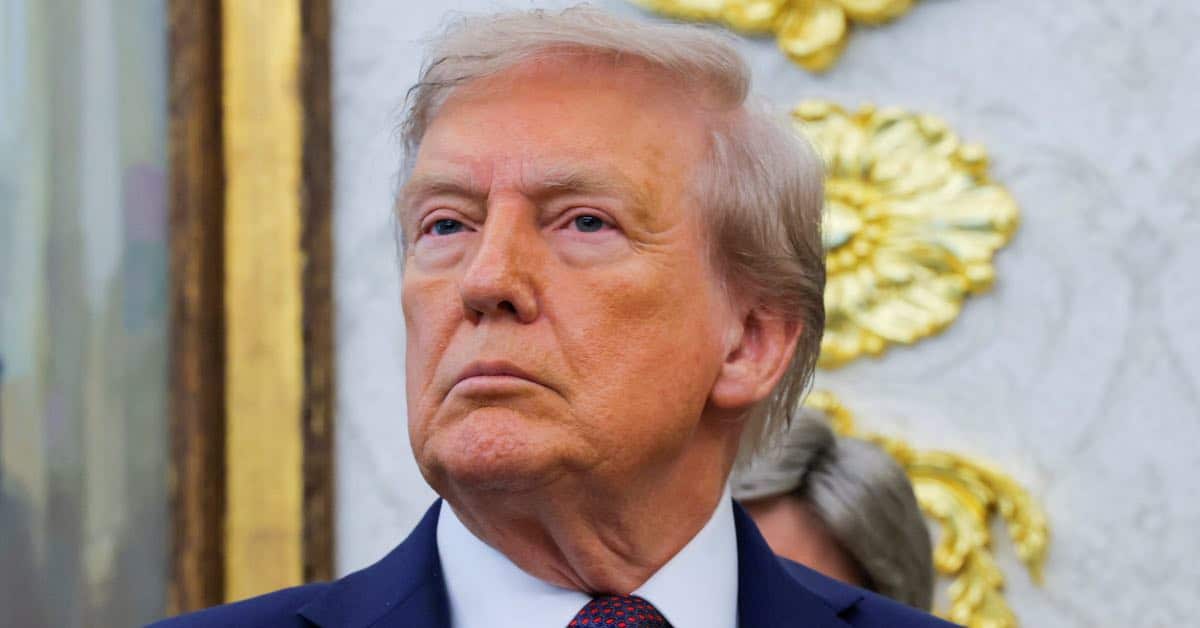
India will say sorry
US Tariffs on India gets more serious as US Commerce Secretary Howard Lutnick recently said that within two months India will apologize and try to strike a deal with Donald Trump; and then it will be entirely Trump’s decision what to do next. That statement itself is bold; it comes right after the United States increased tariffs on Indian exports to a staggering fifty percent. The timing is even more crucial because Prime Minister Narendra Modi was seen at the Shanghai Cooperation Organization summit in Tianjin with Xi Jinping; holding bilateral talks with China which could in theory build a new axis of power in Asia.
Trump reacted strongly and posted on Truth Social that it looks like America has lost India and Russia to China; though he later softened his tone by calling Modi his friend. The overall message however remains mixed and confusing; America feels India is drifting but still wants the relationship intact.
The big question is whether the United States can actually force India to apologize. This is neither entirely impossible nor straightforward. On one hand Trump has the authority and the influence to use economic tools very aggressively; on the other hand forcing a sovereign nation like India into a public apology would be unprecedented. If the US were to go down that route it would likely destabilize its own economy too.
For instance Trump has already urged Big Tech and large manufacturers to stop hiring in India and instead follow his newly announced AI Action Plan which is meant to make the US number one in artificial intelligence. If American companies actually reduce their operations here we could face major unemployment; the ripple effects would be felt across services, outsourcing and the consumer economy.
Another potential measure could be heavy sanctions; the US could restrict Indian goods or services from reaching third markets or even limit access to crucial technologies. The consequences of that would be enormous because our digital backbone is still dependent on global giants. Imagine a scenario where Google or Meta services were restricted even temporarily; the shock to Indian businesses and users would be immediate.
China had the capacity to replace these platforms internally with Baidu, WeChat and others; India has no such large scale ecosystem ready for instant substitution. The outcome would be severe economic instability; it shows why our self reliance programs and domestic technology development are no longer just policy slogans but survival imperatives.
This brings us to the India China dynamic. On paper the two economies can complement each other extremely well. China right now is in deflation; production capacity is high but domestic demand is weak. India is in inflation; demand is strong and labour costs are lower. If these two nations truly combined resources, technology and markets they could form one of the most powerful manufacturing hubs in the world. There is logic to it; China’s efficiency matched with India’s workforce could present a formidable challenge to the United States and Europe. The potential is immense; the threat to US dominance would be equally serious.
But the problem is trust. India and China do not share a friendly history. The memories of the 1962 Sino Indian war, the issues around Tibet, the repeated border clashes including Galwan, China’s support for Pakistan, and its constant vetoes against India in international platforms like the UN Security Council have built up decades of suspicion. Even though India was the first non communist country to recognize the People’s Republic of China and signed the Panchsheel Agreement in the 1950s; those warm slogans of Hindi Chini Bhai Bhai collapsed quickly.
The Dalai Lama’s asylum in India, the annexation of Tibet, and territorial disputes have kept the relationship unstable. This is why despite Modi’s meeting with Xi Jinping in Tianjin he deliberately skipped the Victory Day Parade in China the next day; so as not to offend Japan. That is a clear sign that this is not a sudden love affair but a cautious exploration.
The US tariffs on Indian goods, raised as high as 50%, may not last long because they are already under legal and economic pressure; US courts have ruled that these tariffs violate the International Emergency Economic Powers Act since such measures need Congressional approval, with a Supreme Court appeal expected by October 14, 2025; at the same time, the economic burden is hitting home as Indian exports like textiles and seafood have become more expensive in the US, raising annual household costs by an estimated $1,200 to $2,800 in 2025, creating political pressure to roll them back.
Meanwhile, the idea of cutting Indian workers out of the system is unrealistic since US industries from technology to pharmaceuticals depend heavily on Indian labor, making such moves self-damaging; India has also pointed to possible WTO violations and is using trade negotiations to build leverage; overall, unless Congress firmly supports the tariffs, they are unlikely to remain in place given the combination of legal defeats, international challenges and economic backlash that place the costs squarely on American consumers.
So what should India really do. The first priority should be strengthening internal resilience. Make in India has to go beyond manufacturing slogans; it has to reach into technology, semiconductors, software, search engines and even social media. The new chip production at 28 nanometer may sound primitive compared to global standards but it is still a start; once capacity is built, scaling and advancing nodes will follow.
If we had our own replacements for critical digital services then even if America tried to pressure us by blocking technology we would have the fallback options. Secondly, India must carefully balance; staying too close to China risks losing trust in the West; staying too dependent on the US risks being pushed around by sanctions. It is a complex game of multipolar diplomacy. The truth is that making the US an enemy would be very costly; yet blindly apologizing would undermine sovereignty. Navigating that middle path will decide whether India emerges as a real power center or gets pulled into someone else’s orbit.
